
 English
 German
  Italian
  Hi, User
 The Complete Guide to Volatility 75 Index: Trading V75 Like a Pro
Ever tried to trade on a weekend only to realize markets are closed? Or watched your trades get destroyed by unexpected news you couldn’t predict? These frustrations prompt thousands of traders to explore the Volatility 75 Index, a market that operates independently of global events and remains active 24/7.
But here’s where most traders get confused: there are actually TWO different types of V75 index: the traditional VIX 75 (the fear index) and Deriv’s V75 (a synthetic index). Trading one like the other is a costly mistake that wipes out accounts fast.
In this guide, you’ll learn exactly what each V75 type is, how they differ, and most importantly, how to trade them without blowing up your account. Let’s cut through the confusion and get straight to what matters.
The Two Types of Volatility 75 Index Explained
VIX 75: The Fear Index

VIX 75 is based on the original Volatility Index created by the Chicago Board Options Exchange. Think of it as Wall Street’s panic meter; it measures how scared investors are about the stock market’s future.
When traders expect big price swings, they buy protective options. This pushes VIX 75 higher. When everyone’s calm and confident, VIX 75 drops. It’s that simple.
VIX 75 takes this fear measurement and amplifies it to approximately 75% annual volatility. That’s massive compared to normal markets.
Key features:

- Goes up when markets crash, and people panic
- Goes down when markets are stable and rising
- Only trades during regular market hours
- Closes on weekends and holidays
- Reacts directly to economic news and world events
Deriv V75: The Synthetic Index
Deriv V75 is completely different. It’s artificially created by computer algorithms using random number generators. It’s not connected to stocks, news, politics, or any real market.
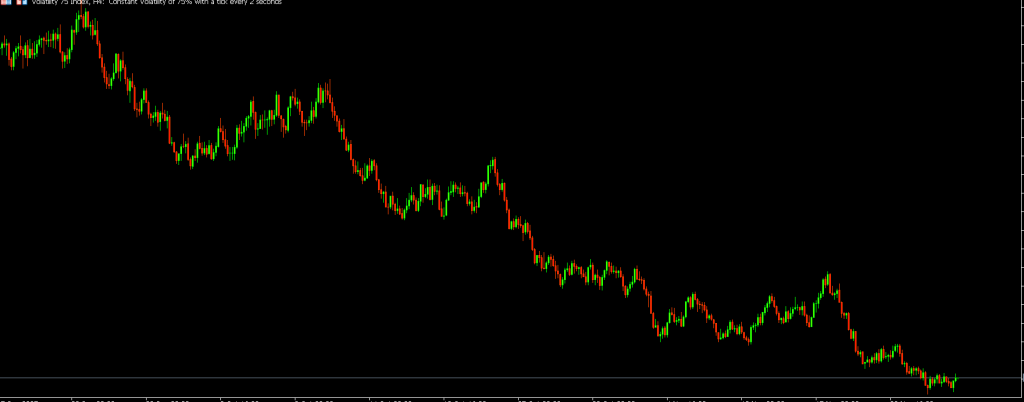
Think of it as a video game version of a volatile market with realistic movements, but nothing in the real world affects it.

Key features:
- Trades 24/7, including weekends
- Never affected by news, politics, or economic reports
- Always maintains 75% volatility (predictable)
- Never has liquidity problems
- Offers leverage up to 1:1000
The bottom line: VIX 75 reflects real market fear. Deriv V75 is a computer simulation with constant volatility. They’re completely different beasts requiring different approaches.
Why Traders Choose V75
Trade Anytime You Want
Deriv V75 never closes. Got a trading idea at 3 AM Sunday? Execute it. Holiday in your country? Doesn’t matter. This means you can trade around your life schedule instead of waiting for markets to open.
Predictable Movement Patterns
Regular markets can be dead calm one day, then explode with movement the next. V75 maintains consistent 75% volatility, which means you can predict roughly how much the market will move. This helps you plan your trades, set better stop losses, and manage risk more effectively.
No Surprise News Events
Remember when COVID-19 news crashed markets overnight? Or when Brexit shocked currency traders? Those surprise events can’t hurt you with Deriv V75. Since it’s computer-generated, political chaos and economic shocks don’t touch it. You’re trading pure price movement patterns without external interference.
Control Your Capital Better
With leverage up to 1:1000, you can control large positions with small capital. A $100 account can control $100,000 worth of trades.

Warning: High leverage is dangerous. It multiplies both wins AND losses. Most professionals use only 1:10 or 1:50 leverage, even when 1:1000 is available. Don’t get greedy—it destroys accounts fast.
How to Trade V75: Simple Strategies That Work
Strategy 1: Follow the Trend
Even volatile markets trend. Your job is spotting the trend direction and riding it.
How to do it:
- Identify if price is moving up or down overall
- Wait for price to pull back against the trend
- Enter when price starts moving with the trend again
- Set your stop loss just beyond the recent high or low
- Target at least twice what you’re risking
The 75% volatility creates strong momentum when trends form. You’ll get false signals, but winners will be big enough to make it profitable.
Strategy 2: Trade Breakouts
When V75 consolidates in a tight range, it’s building energy. The breakout is usually explosive.
How to execute:
- Find areas where price bounces between clear upper and lower boundaries
- Set alerts above and below these boundaries
- When price breaks out with strong momentum, enter the trade
- Stop loss goes inside the old range
- Take profits as the move extends
V75’s consistent volatility ensures breakouts move significantly, not just a few points before reversing.
Strategy 3: Trade the Fear Cycle (VIX 75 Only)
If you’re trading the traditional VIX 75 fear index, you’re trading human emotion.
The approach:
- Watch for major economic events and market uncertainty
- As fear builds before big announcements, VIX 75 usually rises; consider buying
- After events provide clarity, VIX 75 typically falls, consider selling or exiting
- When VIX 75 spikes extremely high during crashes, it often means markets will recover soon
Fear is cyclical. Markets swing from panic to complacency and back. Trading VIX 75 means trading that emotional cycle.
Risk Management: Don’t Blow Up Your Account
This is where most V75 traders fail. The high volatility and massive leverage create perfect conditions for account destruction if you’re careless.
Position Sizing Rule
Never risk more than 1-2% of your account on any single trade. Period.
Here’s the math:
- Account: $1,000
- Risk per trade: 1% = $10
- Stop loss: 20 points away
- Position size: $10 ÷ 20 = $0.50 per point
Calculate position size based on your stop loss distance and risk tolerance, NOT on how much leverage you have available.
Stop Loss Placement
V75 moves fast. Your stops need room to breathe, but not so much that one loss devastates your account.
Guidelines:
- Place stops beyond recent price swings, not random numbers
- Use wider stops than regular forex. V75 is more volatile
- Never move your stop loss to increase risk after entering
- If your stop keeps getting hit, your position size is too large
The Leverage Trap
Just because you CAN use 1:1000 leverage doesn’t mean you SHOULD.
Example of disaster:
- Account: $500
- You use full 1:1000 leverage
- Market moves 0.5% against you
- Loss: $2,500—you’ve lost everything, plus you owe money
Smart traders use minimal leverage. The goal is staying in the game long enough to win, not gambling everything on one trade.
Control Your Emotions
V75 never closes, which makes overtrading dangerously easy. After a loss, the temptation to “win it back immediately” is strong.
Protection tactics:
- Set maximum daily trades and stick to it
- After hitting your daily loss limit (like 3%), stop trading completely
- Take breaks after losses, don’t trade when angry or frustrated
- Log out of your platform if you can’t control the urge to overtrade
Common V75 Mistakes to Avoid
Mistake 1: Treating V75 Like Regular Forex
V75 isn’t just volatile forex. It requires price action strategies, wider stops, and adjusted expectations. Strategies that work on slow-moving currency pairs will get shredded by V75’s speed.
Mistake 2: Using Maximum Leverage
The #1 account killer. Traders see 1:1000 leverage and think they have found easy money. Then one bad trade wipes them out completely. Calculate position size based on your risk limit, not available leverage.
Mistake 3: Confusing VIX 75 with Deriv V75
These are different instruments. VIX 75 responds to news and market fear. Deriv V75 doesn’t. Using fundamental analysis on Deriv V75 is pointless. Ignoring news when trading VIX 75 is equally foolish.
Mistake 4: Trading Without Testing First
The biggest mistake is jumping into V75 with real money immediately. Spend at least 1-2 months trading on a demo account first. Learn how V75 moves without risking capital. Test your strategies. Build confidence. THEN go live with small amounts.
Your V75 Trading Action Plan
Ready to start? Follow these steps in order:
Step 1: Choose your V75 type, fear-based VIX 75, or synthetic Deriv V75
Step 2: Open a demo account and practice for 1-2 months minimum
Step 3: Develop a simple trading plan with clear entry rules, exit rules, and risk limits
Step 4: When you transition to live trading, start with $100-$500 maximum
Step 5: Risk only 0.5-1% per trade initially
Step 6: Keep a trading journal record of every trade, what you did, and why
Step 7: Review your journal weekly to identify what works and what doesn’t
Key Differences: Quick Comparison
Traditional Forex:
- Trades Monday-Friday only
- Volatility changes daily based on news
- Leverage typically 1:30 to 1:500
- Best for traders who follow economic news
Deriv V75:
- Trades 24/7, including weekends
- Consistent 75% volatility always
- Leverage up to 1:1000
- Best for pure technical traders
VIX 75 Fear Index:
- Limited trading hours
- Volatility spikes during market panic
- Tracks real market fear and uncertainty
- Best for traders who understand market psychology
Final Thoughts
The Volatility 75 index offers real opportunities, 24/7 access, predictable volatility, and freedom from surprise news events. But it’s also unforgiving to unprepared traders.
Success with V75 requires three things:
Strict risk management: Never risk more than 1-2% per trade. Use appropriate position sizing. Respect leverage, don’t abuse it.
Adapted strategies: What works on slow markets won’t work here. Develop strategies specifically for high volatility.
Psychological discipline: Don’t overtrade just because the market never closes. Stick to your plan. Accept losses. Avoid revenge trading.
Start with a demo account. Practice for months, not days. When you go live, start small. Scale up only after proving consistent profitability over time.
V75 won’t make you rich overnight. But with proper preparation, realistic expectations, and disciplined execution, it can become a valuable part of your trading approach. Start smart, stay disciplined, and trade wisely.
Post a Reply
You must be logged in to post a comment.