
 English
 German
  Italian
  Hi, User
 What is ECN in Forex? Understanding Electronic Communication Networks for Better Trading
Have you ever wondered why your trades sometimes get rejected, or why you see different prices on different broker platforms? Maybe you’ve heard traders talking about “ECN brokers” and felt confused about whether you should switch from your current broker.
In this guide, I’ll break down exactly what ECN (Electronic Communication Network) means in forex trading, how it works, and why it matters for your trading results. By the end, you’ll understand whether an ECN broker is right for your trading style and how this execution model can impact your price action strategies.
What Does ECN Actually Mean in Forex Trading?
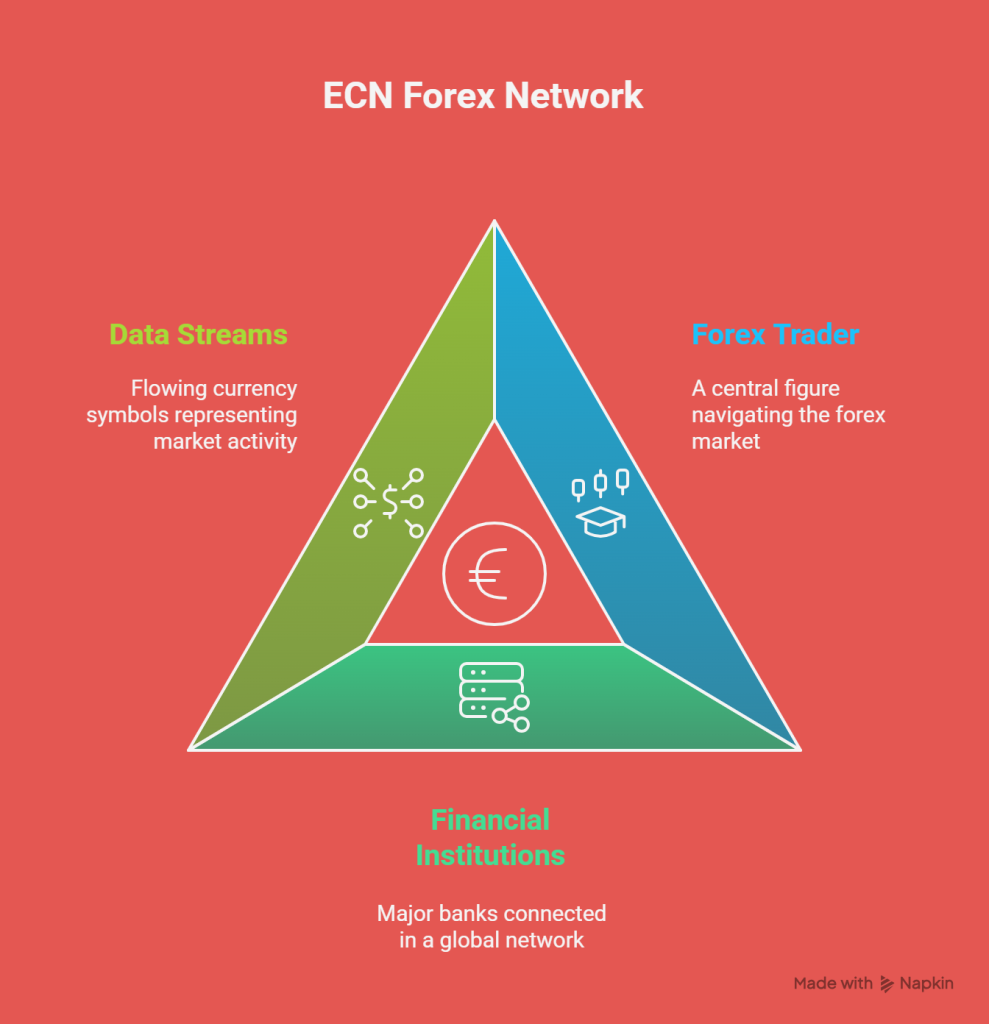
ECN stands for Electronic Communication Network, a computerised system that connects forex traders directly with liquidity providers without a middleman manipulating the process.
Think of it like this: instead of calling a car dealership that marks up the price, you’re accessing a wholesale auction where multiple dealers compete to give you the best price. In forex terms, an ECN broker connects you directly to banks, financial institutions, hedge funds, and other traders, all competing to fill your order at the best available price.
Here’s what makes ECN different:
Direct Market Access: Your orders go straight into a pool of liquidity where prices are determined by real supply and demand, not by a broker’s dealing desk.

Transparent Pricing: You see the actual bid and ask prices available in the market at any given moment—no hidden markups.
No Conflict of Interest: The broker doesn’t trade against you. They simply match your order with the best available counterparty and charge a small commission for the service.
When you place a trade through an ECN broker, your order enters a network where it’s matched with the best available price from multiple sources, including major banks like JP Morgan, Citibank, and other institutional players.
How ECN Execution Works Behind the Scenes
Understanding the execution process helps you appreciate why ECN can improve your trading results, especially when trading price action strategies that require precise entries.

The Order Matching Process:
When you click “buy” or “sell,” here’s what happens in milliseconds:
- Your order enters the ECN network
- The system scans all available bids and offers from liquidity providers
- Your order gets matched with the best available price
- The trade executes automatically
- You receive confirmation
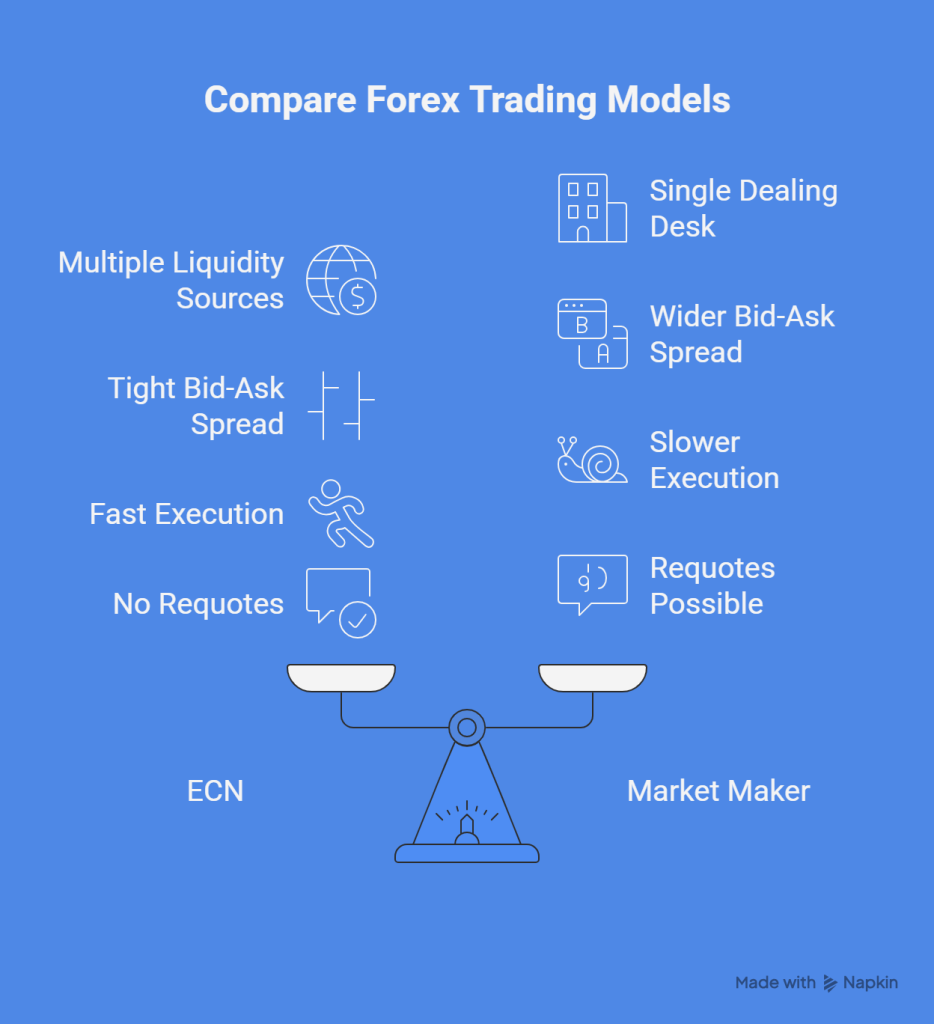
This entire process is automated and typically completes in fractions of a second. There’s no dealing desk reviewing your order, no manual intervention, and no requotes in most cases.
Price Aggregation:
ECN brokers aggregate prices from multiple liquidity sources. At any moment, different banks might be offering slightly different prices for the same currency pair. The ECN system shows you the best bid and best ask available across all these sources.

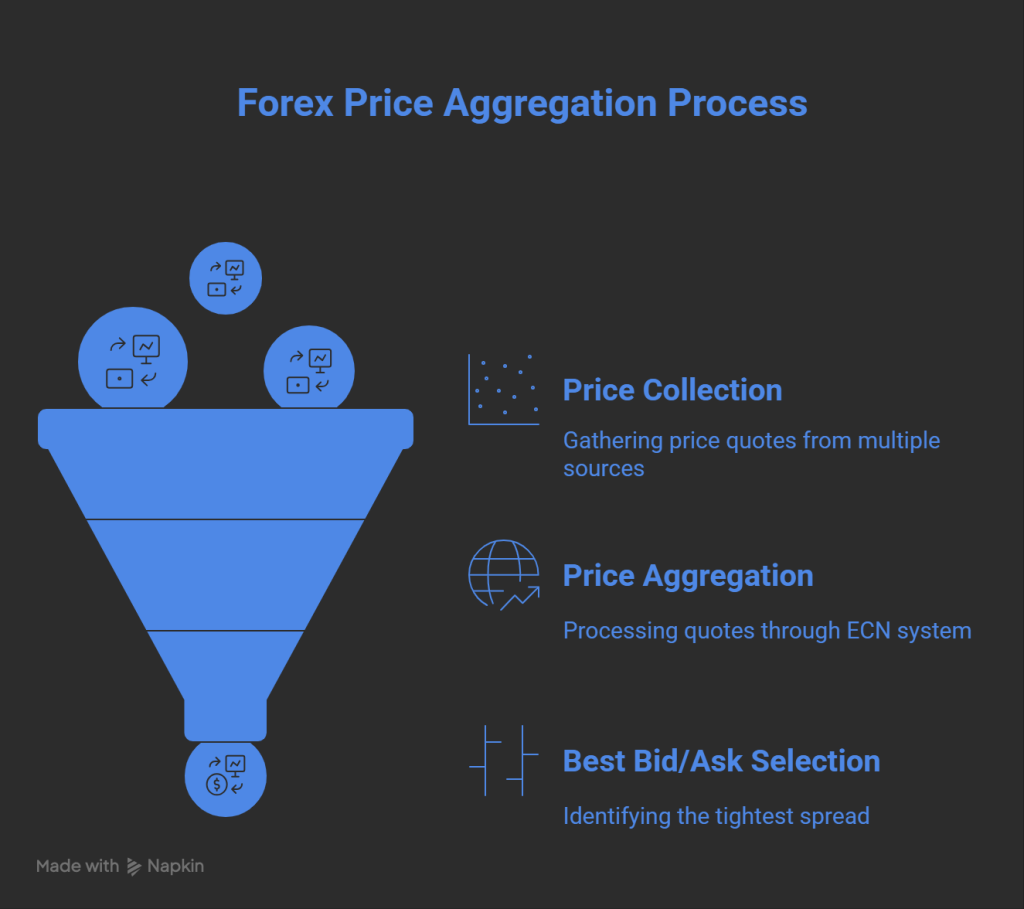
For example, if Bank A offers EUR/USD at 1.1000/1.1002 and Bank B offers 1.0999/1.1001, you’ll see 1.0999/1.1001 on your platform as the tightest spread available.
The Real Advantages of ECN for Price Action Traders
As a price action trader, you rely on accurate prices and clean execution. ECN brokers offer several specific advantages that directly impact your strategy performance.
Tighter Spreads:
Because multiple institutions compete for your order, spreads are often significantly tighter than what dealing desk brokers offer. For major pairs like EUR/USD, ECN spreads can be as low as 0.0-0.2 pips during peak liquidity times, compared to 1-3 pips at traditional brokers.
Why this matters: When you’re trading off precise support and resistance levels, or entering on specific candle patterns like engulfing candles, every pip counts. Tighter spreads mean your trade starts closer to breakeven, improving your risk-to-reward ratio.
No Requotes:
With ECN execution, you almost never experience requotes. When you identify a price action setup, say, a bullish engulfing candle at a key support level, and click to enter, you get filled at the available market price.
Faster Execution:
Automated matching means your orders execute in milliseconds. When you’re trading breakouts from market structure or entering at imbalance zones, speed matters. The difference between getting filled at your intended price versus 2-3 pips away can determine whether your trade is profitable.
Transparency in Pricing:
You see real market prices based on actual supply and demand. This is especially important when analysing supply and demand zones. The prices you see on your charts genuinely reflect where institutional traders are placing their orders.
ECN Commissions: Understanding the Cost Structure
ECN brokers don’t make money from spreads; they charge a commission per trade instead. This pricing model is more transparent but requires understanding how costs work.
Typical Commission Structure:
Most ECN brokers charge between $2.50 to $7.00 per standard lot (100,000 units) per side. This means if you trade one standard lot, you pay the commission when you open the position and again when you close it.
For example, trading 1 standard lot with a $6 round-up commission costs you $6 total. If the spread is 0.1 pips, your total trading cost is the equivalent of about 0.7 pips.
Compare this to a dealing desk broker offering a 2-pip spread with “no commission”, you’re actually paying more, even though they claim zero commission.
Calculating Your True Trading Costs:
To compare brokers accurately, convert everything to pips:
- ECN spread (0.2 pips) + commission ($6 = 0.6 pips) = 0.8 pips total cost
- Market maker spread (2.0 pips) + commission ($0) = 2.0 pips total cost
For active traders taking multiple setups based on indecision candles or market structure breaks, lower overall costs compound significantly.
ECN vs. Market Makers: Which is Better for You?
Not every trader needs an ECN broker. Understanding the difference helps you choose the right execution model.
ECN Brokers Are Better If You:
- Trade with accounts of $500 or more
- Rely on precise entries at specific price action levels
- Trade during high-volatility periods like news releases
- Take multiple trades per day or week
- Need the tightest possible spreads for scalping or breakout strategies
Market Makers Might Work If You:
- Have a very small account (under $200-300)
- Take only a few trades per month
- Trade only during low-volatility periods
- Prefer all-inclusive pricing with no separate commissions
For serious price action traders, ECN execution typically provides better overall value and more reliable fills than market makers.
How to Identify a True ECN Broker
Unfortunately, some brokers claim to offer ECN execution but actually use hybrid models. Here’s how to verify you’re getting genuine ECN access.
Check for These Features:
Variable Spreads: True ECN brokers offer spreads that fluctuate based on market liquidity. If spreads are always the same, you’re likely dealing with a market maker.
Commission Structure: Real ECN brokers charge commissions separately from the spread. If a broker claims “ECN with no commissions,” they’re probably widening the spread to compensate.
Depth of Market: Legitimate ECN platforms show you Level II pricing or depth of market data, displaying multiple price levels with available liquidity.
Fractional Pip Pricing: ECN brokers typically quote prices to the fifth decimal place (0.00001) for major pairs, reflecting the precision of institutional pricing.
Common Mistakes When Switching to ECN
Even experienced traders sometimes stumble when transitioning to ECN execution. Avoid these pitfalls.
Mistake 1: Not Accounting for Commissions in Position Sizing
When you calculate your risk per trade, include the commission cost. If you risk 1% of your account on a trade with a 20-pip stop, don’t forget that commissions effectively add to your risk.
Mistake 2: Trading During Extremely Low Liquidity
ECN spreads widen significantly during very low liquidity periods, like between Friday close and Sunday open, or during major holidays. Stick to high-liquidity trading sessions for the best results.
Mistake 3: Expecting Zero Slippage
ECN execution is fast and transparent, but slippage still occurs during extreme volatility. The difference is that ECN slippage represents genuine market conditions, not broker manipulation.
Making the Switch: Is ECN Right for Your Trading?
After understanding what ECN means and how it works, you can make an informed decision about whether ECN execution fits your trading approach.
ECN makes sense if you’re a serious trader committed to price action strategies who takes multiple trades per week. The combination of tighter spreads, faster execution, and transparent pricing gives you measurable advantages, especially when trading around key support and resistance levels, market structure breaks, or candlestick patterns like engulfing candles.
Start Here:
- Research regulated ECN brokers with strong reputations
- Open a demo account and test execution during various market conditions
- Compare total trading costs (spreads plus commissions) against your current broker
- Start with a small live account to verify real execution matches demo performance
ECN execution isn’t magical; it won’t turn a losing trader into a winner. But if you have a solid price action strategy and understand concepts like supply and demand zones, support and resistance, and market structure, ECN execution gives you a cleaner, more professional trading environment.
Your next step is to evaluate your current broker’s execution model and compare it with reputable ECN alternatives. For more insights on choosing the right broker execution model, check out our comparison guide on STP vs ECN brokers to understand all your options.
Remember: the best execution model is the one that aligns with your trading style, account size, and strategy requirements. Take time to research, test, and choose wisely. Your trading results will reflect that decision.
Post a Reply
You must be logged in to post a comment.