
 English
 German
  Italian
  Hi, User
 What is a Break of Structure in Supply and Demand Trading?
Ever jumped into a strong trend just before it reversed against you? Identifying when a trend continues versus when it collapses is one of the biggest struggles for forex traders.
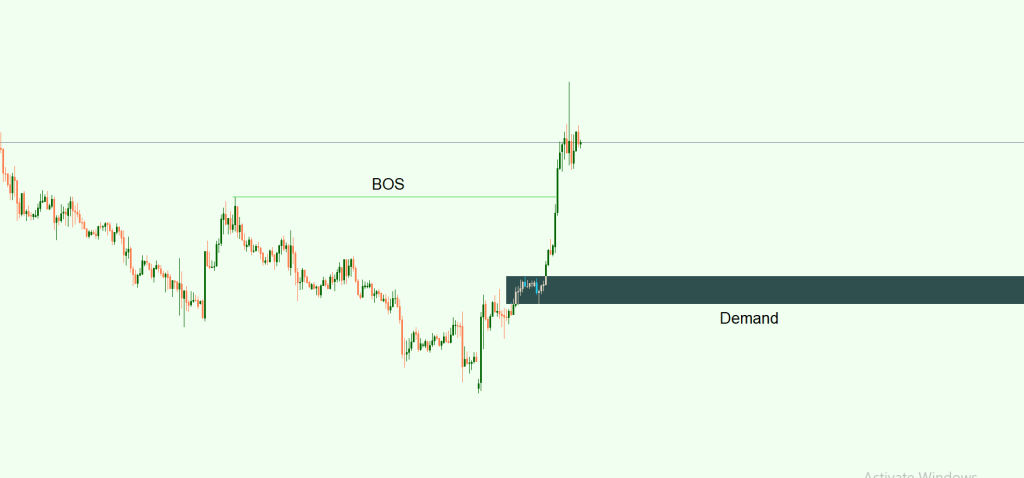
Understanding break of structure (BOS) eliminates this guesswork. I’ll explain what BOS is, how to spot it, and how to use it for precise entry timing. You’ll gain a clear framework for reading market momentum across any currency pair or time frame.
What is a Break of Structure?
A break of structure is a price action signal confirming market momentum continues in a specific direction strongly. When price breaks beyond the most recent significant high in an uptrend (or low in a downtrend), it creates a BOS, telling you buyers or sellers have strength to push beyond previous obstacles.
The market moves in waves, impulses, and corrections. Break of structure marks the correction’s end and the next impulse’s beginning. Identifying this transition gives you a massive edge in timing entries.
In an uptrend: price rallies, pulls back, then rallies again. The second rally, pushing above the previous high, is your break of structure, confirming that buyers remain in control.
The psychology: when price breaks a previous high, it triggers stop losses from traders betting against the trend and attracts new buyers seeing continuation. This combination creates momentum, propelling price further.

Understanding Market Impulse and Correction
To master break of structure, understand trending market rhythm. Every trend has impulse moves and corrections.
An impulse is the strong directional move where price aggressively pushes up or down with powerful candles showing clear intent.
A correction is the pause after an impulse. Price retraces, often trapping traders who think the trend ended, before the next impulse begins.
Break of structure happens when correction ends and the next impulse begins. When price breaks the previous swing high, the correction is complete.

Think of ocean waves. Impulse crashes forward. Correction pulls back. Break of structure is the next wave pushing beyond the previous wave.
Watch for pullback, base formation near demand, then break above the previous swing high. This repeats throughout trends.
How BOS Relates to Supply and Demand Zones
Break of structure and supply and demand zones work together powerfully. Supply and demand zones are areas where significant buying or selling pressure originated.
The best BOS setups occur when price pulls back into a fresh demand zone during an uptrend, then breaks structure upward. This gives two confirmations: price returned to where buyers showed strength, and BOS confirms buyers are active again.
Real scenario: Price trends up, creates an impulse, leaving a demand zone, then corrects into that zone. When price rallies and breaks above the previous swing high—that’s your BOS signal with demand support and momentum confirmation.
Demand zones attract buyers. Break of structure proves they showed up.

Trading Break of Structure: Practical Entry Strategy
Here’s how to trade break of structure in an uptrend:
Step 1: Identify the Trend – Confirm higher highs and higher lows.
Step 2: Wait for Correction – Let price pull back into a demand zone.
Step 3: Mark the Structure – Identify the most recent swing high.
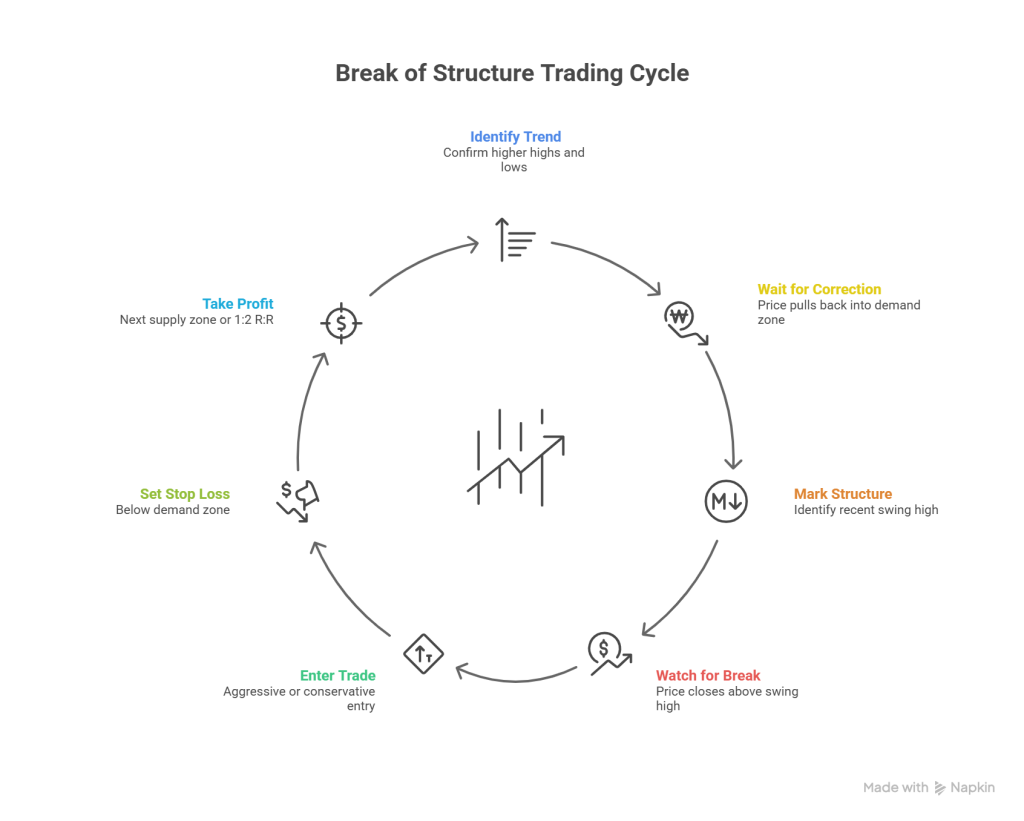
Step 4: Watch for the Break – Price must close above with a candle.
Step 5: Enter – On break (aggressive) or pullback (conservative).
Step 6: Stop Loss – Below the demand zone.
Step 7: Take Profit – Next supply zone or 1:2 risk-reward minimum.
This removes emotion—you’re waiting for market proof.
Common Mistakes When Trading BOS
Trading False Breaks – Wait for candle close above structure with 5-10 pips clearance, not just a wick.
Ignoring Larger Timeframes – Check higher timeframes. A 15-minute BOS means nothing if 4-hour shows major supply ahead.
Entering Too Late – Enter on break or immediate pullback. Don’t chase.
Forgetting Confluences – Stack factors: demand + BOS + round number + Fibonacci creates stronger setups.
Poor Risk Management – Never risk more than 1-2% per trade. Structure can break both directions.
Conclusion: Mastering Break of Structure
Break of structure is one of the most reliable and effective price action tools available. BOS confirms momentum continuation—the current trend has strength and will likely continue moving forward.
Review your charts and identify past breaks of structure. Notice how they occurred at transitions between corrections and impulses. See how the strongest setups came from quality demand and supply zones.
Action steps: Focus on trending markets only. Combine BOS with demand or supply zones for higher-probability setups. Manage risk religiously. Keep a trading journal.
As you develop this skill, you’ll read market momentum with confidence. You’ll stop second-guessing and start trusting the structure.
Now review your charts, mark structure levels, and spot high-probability BOS setups. The market shows you where it wants to go—break of structure teaches you to read that message.
Post a Reply
You must be logged in to post a comment.