
 English
 German
  Italian
  Hi, User
 STP vs ECN Brokers: The Ultimate Guide for Forex Traders
The forex market operates 24/5, churning through trillions of pounds daily, yet most traders remain blissfully unaware of the critical infrastructure powering their trades.
Behind every successful position lies a fundamental choice that could make or break your trading strategy: the type of broker execution model you’re using.
STP vs ECN brokers – two acronyms that sound like technical jargon but represent vastly different trading experiences.
One promises direct market access with raw spreads, whilst the other offers streamlined execution through liquidity providers.
The difference between these models isn’t just academic; it’s the difference between paying unnecessary markups and accessing institutional-grade pricing.
Your broker’s execution model affects everything from spread costs to order execution speed, yet most traders select brokers based solely on marketing promises rather than understanding these fundamental differences.
The question isn’t whether STP or ECN is “better” – it’s which model aligns with your trading style, capital requirements, and profit expectations.
UNDERSTANDING STP BROKERS: THE MARKET INTERMEDIARY
Straight Through Processing (STP) brokers function as sophisticated middlemen, routing your orders directly to liquidity providers without manual intervention.

Think of them as the well-dressed concierge at an exclusive club they know exactly where to send you for the best service, but they’re not the ones providing it.
STP brokers aggregate prices from multiple liquidity sources, including banks, financial institutions, and other market makers.
When you place a trade, the system automatically selects the best available price from these providers and executes your order instantly.
This process happens in milliseconds, creating the illusion of seamless market access.

To totally grasp what this is all about, you may want to go further and understand market makers vs ECN broker models and how they fundamentally shape your trading experience.
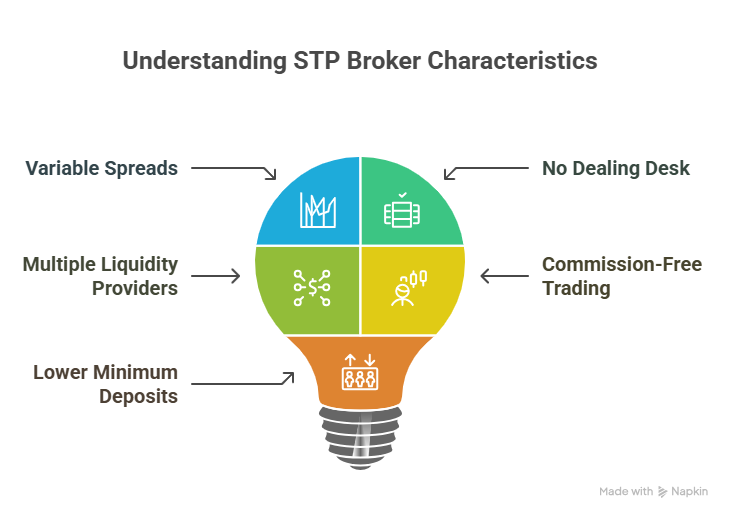
Key Characteristics of STP Brokers:
- Variable spreads that fluctuate with market conditions
- No dealing desk intervention in trade execution
- Multiple liquidity providers creating competitive pricing
- Commission-free trading (costs built into spreads)
- Lower minimum deposits compared to ECN brokers
The beauty of STP execution lies in its transparency. Your broker doesn’t take the opposite side of your trades, eliminating potential conflicts of interest.
Instead, they profit from the spread markup a small addition to the raw market spread that covers their operational costs and generates revenue.

IS FOREX.COM AN ECN BROKER?ECN BROKERS: DIRECT MARKET ACCESS EXCELLENCE
Electronic Communication Network (ECN) brokers represent the apex of forex trading infrastructure.
Unlike STP brokers, ECNs create a genuine marketplace where all participants retail traders, institutions, hedge funds, and banks interact directly through a centralized electronic system.
An ECN functions like an exclusive trading floor where every participant’s orders are displayed anonymously in a central order book.
When your buy order matches someone else’s sell order at the same price, the trade executes automatically. This creates the most transparent trading environment possible in retail forex.
The major difference between STP and ECN brokers becomes apparent in their pricing structure. ECN brokers charge raw spreads the actual market spreads with no markup plus a separate commission per trade.
This transparent fee structure often results in lower total trading costs, particularly for high-volume traders.
ECN Broker Advantages:
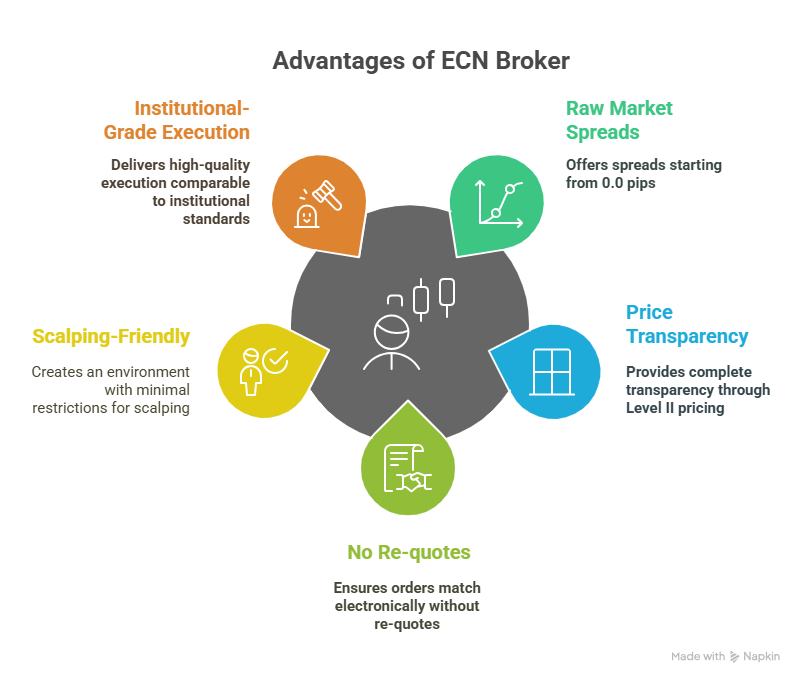
- Raw market spreads starting from 0.0 pips
- Complete price transparency through Level II pricing
- No re-quotes as orders match electronically
- Scalping-friendly environment with minimal restrictions
- Institutional-grade execution quality
Typical STP vs ECN Cost Comparison:
- 1 Standard Lot EUR/USD: STP costs 1.5 pips total, whilst ECN charges 0.1 pips plus $7 commission, resulting in $3 savings with ECN
- 10 Standard Lots: STP costs 15 pips versus ECN’s 1.0 pip plus $70 commission, delivering $50 savings with ECN execution
- 100 Standard Lots: STP’s 150 pips compared to ECN’s 10 pips plus $700 commission shows $500 savings with ECN model
The mathematics become compelling as your trading volume increases. High-frequency traders and scalpers particularly benefit from ECN execution, as the transparent pricing eliminates the hidden costs embedded in STP spreads.
STP VS ECN BROKERS: THE TRADER’S CHOICE ANALYSIS
Choosing between STP and ECN execution isn’t about finding the “best” option“. it’s about matching your trading profile with the appropriate infrastructure.
Like selecting between a sports car and a luxury saloon, both serve different purposes excellently.
When STP Brokers Excel
Beginning traders often find STP brokers more accessible due to lower minimum deposits and simplified fee structures. The commission-free trading appeals to those who prefer predictable costs embedded in spreads rather than separate charges per trade.
Swing traders and position traders benefit from STP execution as the slightly wider spreads become negligible when holding positions for days or weeks. The variable spread structure also provides flexibility during different market conditions.
Lower-volume traders typically achieve better overall costs with STP brokers, as the commission charges on ECN accounts can exceed the spread savings for smaller trade sizes.
ECN Advantages for Serious Traders
Scalpers and high-frequency traders find ECN execution indispensable due to the minimal spreads and superior order execution speeds. The transparent pricing eliminates guesswork about true trading costs.
Professional traders appreciate the institutional-grade infrastructure and direct market access that ECN provides. The ability to see market depth through Level II pricing offers valuable insights for timing entries and exits.
Large account holders benefit significantly from ECN cost structures, as the commission model becomes increasingly economical with higher trading volumes.
TECHNICAL EXECUTION DIFFERENCES
The technical infrastructure underlying STP and ECN execution creates distinct trading experiences that extend beyond simple cost comparisons.
Order execution speed varies between models due to different processing requirements. STP brokers must route orders through their liquidity provider network, adding minimal latency.
ECN systems match orders within their electronic network, often providing faster execution but requiring more sophisticated technology infrastructure.
Slippage characteristics differ significantly between execution models. STP brokers may experience slippage during volatile market conditions when liquidity providers widen spreads or reduce available volume.
ECN systems typically provide more consistent execution as orders match at specific price levels without re-quotes.
Available trading instruments can vary between broker types. Some ECN brokers focus exclusively on major currency pairs to maintain optimal liquidity, whilst STP brokers often offer broader instrument selections including exotic pairs and CFDs.
REAL-WORLD COST ANALYSIS
Understanding the true cost implications requires examining various trading scenarios beyond simple spread comparisons.
Day trading scenarios: A trader executing 10 standard lots daily on EUR/USD would pay approximately $150 weekly in STP spreads versus $70 in ECN commissions plus $10 in raw spreads representing $70 weekly savings with ECN execution.
Position trading scenarios: Holding trades for weeks reduces the impact of execution costs relative to potential profits.
A position trader might find STP execution perfectly adequate, especially considering the lower minimum deposit requirements.
News trading implications: ECN brokers typically maintain normal operations during high-impact news events, whilst some STP brokers may widen spreads significantly or restrict trading.
For news traders, this difference can be crucial.
MAKING YOUR DECISION
The choice between STP and ECN execution ultimately depends on your trading profile, capital allocation, and performance expectations.
Questions like “Is Deriv an ECN broker” become relevant when evaluating specific brokers against your requirements.
Consider STP brokers if you:
- Trade with smaller account sizes (under $10,000)
- Execute fewer than 50 trades monthly
- Prefer simplified, commission-free pricing
- Focus on longer-term trading strategies
- Want lower minimum deposit requirements.
Choose ECN brokers if you:
- Maintain larger trading accounts ($25,000+)
- Execute high-frequency or scalping strategies
- Require institutional-grade execution quality
- Value complete pricing transparency
- Trade significant volumes regularly.
INDUSTRY EVOLUTION AND FUTURE TRENDS
The forex brokerage industry continues evolving, with hybrid models emerging that combine STP and ECN features.
Some brokers offer account tiers that automatically upgrade clients to ECN execution once they meet specific volume or balance requirements.
Regulatory developments increasingly favour transparent execution models, potentially driving more brokers toward ECN-style operations.
The European Securities and Markets Authority (ESMA) and Financial Conduct Authority (FCA) continue implementing measures that promote fair pricing and execution quality.
Technology improvements are reducing the technical barriers between STP and ECN execution.
Advanced STP systems now offer near-ECN performance levels, whilst ECN brokers are lowering minimum requirements to attract smaller traders.
CONCLUSION
The STP vs ECN broker decision represents one of the most important choices in your trading journey.
Understanding these execution models empowers you to select infrastructure that supports rather than hinders your trading objectives.
STP brokers excel for beginners and moderate-volume traders who value simplicity and lower barriers to entry.
ECN brokers provide superior value for serious traders who require institutional-grade execution and transparent pricing.
Your broker choice should align with your trading style, account size, and performance goals. Don’t let marketing rhetoric obscure the fundamental differences between these execution models.
Ready to optimise your trading infrastructure? Research brokers based on their execution model rather than promotional offers.
Your future trading success depends on choosing the right foundation from the start.
Compare real costs using your typical trading patterns, test execution quality during various market conditions, and select the model that genuinely supports your trading objectives.
The difference between mediocre and exceptional trading results often lies in these seemingly technical details.
Post a Reply
You must be logged in to post a comment.